Emergency Tree Services and Controlled Limb Lowering
When a tree fails, the job changes instantly. Routine pruning becomes hazard management. A simple removal turns into a coordinated effort to protect roofs, vehicles, utility access, fences, and people who are often standing far too close to the problem. Emergency Tree Services exist for that narrow band of work where time matters, risk is active, and every cut has consequences.
That is where controlled limb lowering earns its place. It is not just a technique for making a job look tidy. It is one of the practical methods trained crews use to manage weight, direction, and impact when branches or leaders cannot be dropped freely. In storm response, partial tree failure, or Dangerous Tree Assessment and Removal, the difference between letting wood fall and lowering it under control can be the difference between a manageable repair and a secondary emergency.
Anyone who has spent time around storm damage learns the same lesson early. The tree that looks almost down is often the one that demands the most patience. Broken tops can hang in a neighboring crown. Split stems can stay standing under tension. A large limb can appear stable from the ground while the attachment point is barely holding. Emergency work is rarely about speed alone. It is about judgment under pressure.
Why emergency tree work demands a different mindset
Tree work is inherently physical and, at times, dangerous. Industry guidance is clear on that point, especially with large trees and removals. In an emergency, the usual variables multiply. Wind may still be moving the canopy. Soil may be saturated. Access can be blocked. Clients are stressed, and they often want immediate action before anyone has had time to assess how the tree is loaded.
That assessment matters. Tree risk guidance in arboriculture treats risk as something to identify, analyze, and evaluate systematically. The goal is not to pretend that a tree can be made perfectly safe. It cannot. Some level of risk always exists. The goal is to reduce risk to an acceptable level without reaching for unnecessary intervention.
That distinction matters in the field. A homeowner may assume every storm-damaged tree needs full Tree Removal Services. Sometimes it does. Sometimes the right answer is a targeted reduction cut, removal of a failed lead, or temporary stabilization while the site is made safe. A mature tree with one failed scaffold branch is not automatically a removal candidate. On the other hand, a tree with significant structural failure over a house may not leave much room for preservation. Experience shows up in those gray areas.
A proper response begins with reading the tree, the target area, and the failure pattern. Where is the weight now? What is still attached? What could move when the first cut is made? Is the root plate stable? Is there enough room for free fall, or will every major piece need to be rigged and lowered? Those are not academic questions. They determine the work plan.
What controlled limb lowering actually means on site
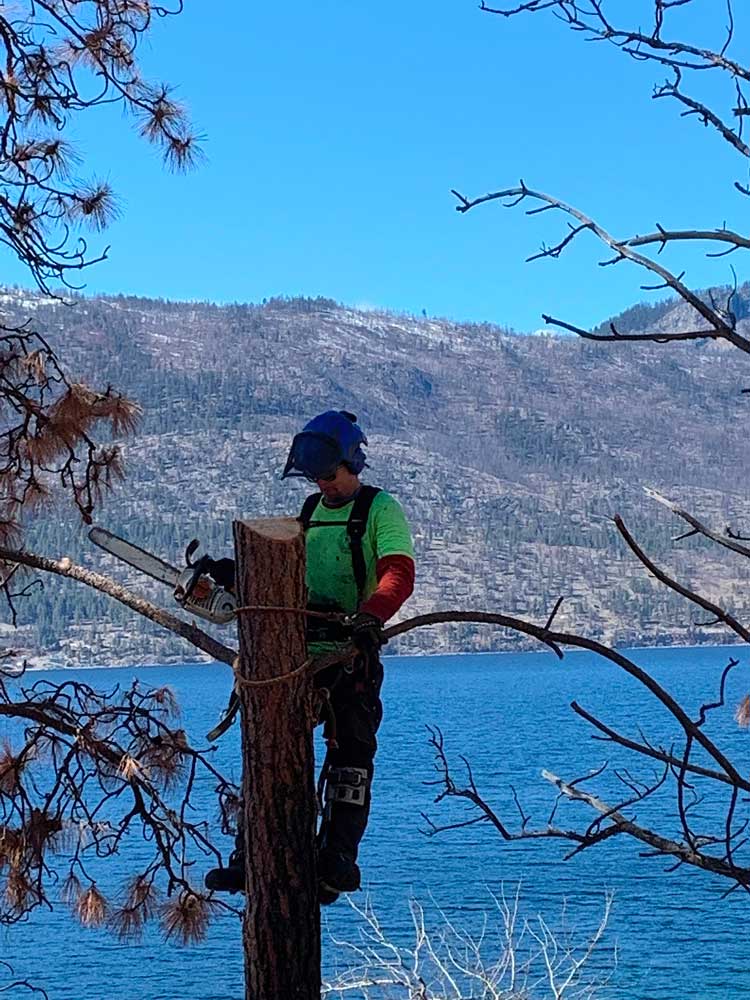
Controlled limb lowering is a rigging approach used to bring cut sections of a tree to the ground in a managed way rather than allowing them to drop uncontrolled. In practical terms, a crew uses ropes and rigging methods so a limb, top, or stem section can be supported, guided, and lowered into a predetermined landing zone.
That sounds straightforward until you see the variables involved. Wood is heavy, but not uniformly so. A long, brushy limb can be awkward in ways that a shorter log section is not. Weight sits farther from the attachment point. The limb may swing as fibers separate. Nearby structures narrow the drop zone. One poorly placed cut can cause a section to roll, twist, or shock-load the rigging. Controlled lowering is not simply tying a rope onto a branch. It is a sequence of decisions about balance, load path, cutting order, and communication.
In emergency conditions, those decisions become even more important. A storm-broken limb often contains hidden tension or compression. The wood may be cracked, splintered, or partially detached. The natural hinge that guides a standard pruning or removal cut may not behave normally in damaged timber. That is one reason trained and properly equipped crews are essential in this kind of work.
There is also a common misconception worth correcting. Controlled lowering is not only for very large removals. It is often just as useful on medium-sized pieces when the target area is tight. A relatively modest limb over a glass sunroom, ornamental planting bed, or narrow access lane can require more precision than a bigger limb over open lawn.
The role of the Certified Arborist Consultation
During emergencies, people understandably focus on the visible mess. The branch on the garage roof gets all the attention. The stem leaning over the driveway becomes the main concern. Yet the first visible failure is not always the whole problem.
A Certified Arborist Consultation brings a more disciplined approach to what happened and what should happen next. ISA Certified Arborists are trained in the art and science of tree care, they must pass a comprehensive exam, continue their education, and work under a professional code of ethics. That matters because emergency decisions often involve more than one valid option.
A certified arborist may determine that the immediate objective is simply to remove the failed section, restore site access, and leave the standing portion for a fuller follow-up evaluation. In another case, the pattern of failure may indicate that the remaining structure is unreliable, making Dangerous Tree Assessment and Removal the most defensible choice. Sometimes mitigation rather than removal is appropriate, particularly where risk can be reduced through selective Tree Pruning & Crown Shaping Tree Pruning & Crown Shaping or structural support.
The best consultations are not theatrical. They are calm, methodical, and honest about uncertainty. No credible arborist promises a zero-risk tree, because such a thing does not exist. Instead, the discussion centers on likelihood, consequence, and practical next steps.
When pruning, support, or removal is the right call
Emergency response often gets described as if there are only two choices, save the tree or remove it. In reality, the middle ground is where professional judgment earns its keep.
Tree Pruning & Crown Shaping can reduce risk when the tree remains structurally serviceable and the damaged portions can be removed with proper cuts. Standards-based pruning matters here. Correct branch removal and reduction cuts support compartmentalization and preserve as much sound structure as possible. Improper practices such as topping or leaving stubs do not solve structural problems well, and they can create new ones.
Tree Cable and Bracing may also enter the conversation when the issue involves structural weakness rather than complete failure. Structural support systems are recognized arboricultural treatments, but they are not a shortcut around poor judgment. They are appropriate only in the right tree, with the right defect profile, and with a clear understanding that support systems reduce risk rather than eliminate it.
Then there are cases where Tree Removal Services are plainly necessary. A tree with significant failure in a high-target area, a compromised main stem, or damage that leaves no reliable structure to retain may need complete removal. In emergency settings, the timing of that decision can be critical. Delay can increase exposure if the remaining parts of the tree are unstable.
The point is not to preserve at all costs or remove at the first sign of trouble. The point is to match the response to the actual condition of the tree and the actual risk on site.
How a controlled lowering operation typically unfolds
The public often notices the climber first, but the operation is usually won or lost before the first piece is cut. Access, drop zone selection, anchor planning, and crew communication shape the job long before wood moves.
A typical emergency setup starts with isolating the work area and identifying where lowered material can land safely. The crew then decides whether pieces can be lowered directly, guided away from targets, or broken into smaller sections to reduce force and improve control. Size is not chosen for convenience alone. It is chosen to keep the load manageable and predictable.
Communication during this phase needs to be simple and exact. Storm response can be noisy, and visual obstructions are common. The climber and ground crew must share the same expectations about when a line is tensioned, when a cut begins, and where the piece is intended to travel. Small misunderstandings become large problems quickly when wood is suspended.
Several field realities influence how pieces are lowered:
- The shape of the limb matters as much as its weight.
- Damaged wood can react differently than sound wood during the cut.
- Tight targets often require smaller sections and slower progress.
- Ground conditions affect where material can be received and processed.
- The safest plan sometimes sacrifices speed for control.
That last point deserves emphasis. Homeowners often expect emergency crews to work fast, and in many cases they do. But experienced crews know when not to rush. If the target area is narrow or the wood is unstable, a slower lowering sequence is usually the safer choice.
The difference between emergency removal and routine removal
Routine removals usually allow for cleaner planning. The weather is calmer. Access is easier. The tree has not just been torn apart by wind or loaded by ice. In those cases, removal can still involve rigging and controlled lowering, but the structure is often more predictable.
Emergency removals are different because the tree may already be partially dismantled by failure. A branch union may be split. A leader may be hung up in an adjacent tree. The top may have rotated, changing how the stem is loaded. Even the root system may be affected if the tree has shifted in saturated ground.
This https://travisjfkp531.fotosdefrases.com/firesmart-tree-services-to-protect-your-property is why Dangerous Tree Assessment and Removal should never be reduced to a visual guess from the curb. The visible damage is only part of the picture. A trained eye looks for the mechanics behind the damage. Which fibers are holding? Which parts are in tension? Which defects existed before the storm and helped produce the failure? Those details guide whether controlled lowering is feasible, whether mechanical assistance is needed, or whether access should be restricted until the site can be stabilized.
For clients, the practical takeaway is simple. Emergency tree work is not merely routine tree work performed faster. It is a separate category of response with higher stakes and narrower margins.
What happens after the canopy is on the ground
Once the immediate hazard is removed, the job often shifts from emergency response to restoration. This is where property owners start asking the next round of questions. Should the remaining stump stay? Does the tree need to be replaced? Can the neighboring trees be pruned to reduce future storm exposure?
Stump Removal & Grinding frequently comes up at this stage. It is not always part of the initial emergency visit, especially if the priority is simply to eliminate immediate risk and clear access. But once the site is stable, stump work can help restore usable space and prepare the area for replanting or landscape repair.
Follow-up pruning may also be appropriate for nearby trees that showed weak attachments, crowding, or poor structure during the event. Tree Pruning & Crown Shaping is often more valuable after a storm than before homeowners realize. Not because pruning can prevent all failures, it cannot, but because thoughtful pruning can improve structure, reduce certain end-weight issues, and remove compromised limbs before the next weather event tests them.
This is also a sensible moment for broader property planning. A yard that has just experienced one emergency often reveals where future emergencies are most likely to start.
Fire risk, storm risk, and long-term management
Although storm response gets most of the attention, emergency readiness also overlaps with wildfire resilience in many regions. FireSmart Tree Services are part of the same broader conversation about managing vegetation with risk in mind. The exact prescriptions depend on local conditions and site design, but the principle is familiar to arborists: reduce avoidable exposure before a bad day arrives.
That might involve identifying trees with dead material, poor spacing, or structural issues near structures and access routes. It might also mean planning maintenance so crews are not trying to make high-pressure decisions during a storm, after a wind event, or under urgent fire weather conditions.
Long-term management tends to be less dramatic than emergency response, but it is often where the best outcomes are built. A property with periodic Certified Arborist Consultation, timely pruning, and realistic risk discussions usually avoids the worst surprises. Not all of them, because trees are living structures exposed to weather and age, but many of them.
Questions property owners should ask before authorizing emergency work
Homeowners are often making decisions under stress, sometimes late in the day and with visible damage in front of them. That is exactly when clear questions help.
- Is the immediate goal hazard reduction, full removal, or temporary stabilization?
- Does the remaining tree appear suitable for retention, or is full removal likely?
- Will parts be free-dropped, or will controlled limb lowering be required?
- What follow-up work may be needed after the emergency phase?
- Is a Certified Arborist Consultation recommended for the remaining trees on site?
These questions do not turn a client into an arborist, but they do slow the decision-making just enough to clarify scope and intent. That is useful for everyone involved.
Why experience matters more than theatrics
Emergency tree work can look dramatic from the ground. Ropes are moving, saws are running, and large pieces are coming down close to structures. But the crews that inspire confidence over time are not usually the loudest or the fastest-talking. They are the ones who read the tree carefully, explain the trade-offs plainly, and adjust the plan when the wood tells them something different than expected.
Controlled limb lowering is a good example of that professional temperament. It is not flashy by itself. In fact, when it is done well, the operation can seem almost uneventful. A heavy limb swings a little, settles into the line, and reaches the ground exactly where it was supposed to go. No roof impact, no fence damage, no frantic improvisation. The absence of drama is the success.
That understated competence is what property owners should want from Emergency Tree Services. Not bravado, not shortcuts, and not promises that every damaged tree can be saved or every risk removed. Good arboricultural practice is more measured than that. It accepts that tree risk is real, that some decisions are difficult, and that the safest path often comes from careful assessment, proper equipment, and techniques such as controlled lowering applied by trained professionals.
When a tree fails near a home or business, the urgency is real. So is the temptation to act on the first available opinion. The better course is to combine urgency with discipline. Assess the tree. Define the target. Choose the least risky practical method. Use controlled limb lowering where free-fall cuts are not acceptable. Then decide, with professional judgment, whether the right next step is pruning, support, complete removal, stump grinding, or longer-term property planning.
That is how emergency work protects both people and trees when it still can, and how it avoids turning one failure into several.
Name: Ace Tree Services Ltd.
Address: 4656 Wallace Hill Road, Kelowna, BC
Phone: 250-212-9593
Website: https://acetree.ca/
Hours:
Monday: 7:00 AM–5:00 PM
Tuesday: 7:00 AM–5:00 PM
Wednesday: 7:00 AM–5:00 PM
Thursday: 7:00 AM–5:00 PM
Friday: 7:00 AM–5:00 PM
Saturday: 7:00 AM–5:00 PM
Sunday: Closed
Emergency tree services: 24/7 emergency service is listed.
Open-location code / Plus code: RHF8+8G Kelowna, British Columbia, Canada
Map/listing URL: https://www.google.com/maps/place/Ace+Tree+Services+Ltd./@49.8232606,-119.4337283,563m/data=!3m1!1e3!4m6!3m5!1s0x537d8b1d074815c5:0x450b88afa7a41435!8m2!3d49.8232606!4d-119.4337283!16s%2Fg%2F11ydkpnh22
Embed iframe:
Socials: https://www.facebook.com/people/Ace-Tree-Services/61585901931447/
https://m.yelp.com/biz/ace-tree-services-kelowna
Ace Tree Services Ltd. provides professional tree service for residential, commercial, and municipal customers in Kelowna and across the Okanagan Valley.
The company’s listed services include tree removal, stump removal and grinding, tree pruning and crown shaping, emergency tree services, certified arborist consultation, dangerous tree assessment, tree cable and bracing, and wildfire mitigation.
Ace Tree Services works with homeowners, businesses, property managers, and public-sector clients that need safe, practical tree care in the Kelowna area.
The official site highlights ISA-certified arborists, insurance, and experience handling both routine and complex tree service situations.
Customers can contact Ace Tree Services for tree care planning, hazard concerns, emergency tree cleanup, pruning needs, stump grinding, or advice about trees near homes, fences, driveways, and landscaping.
Ace Tree Services lists regular work hours from 7:00 AM to 5:00 PM Monday through Friday, with 24/7 emergency tree service available for urgent situations.
For tree service in Kelowna, call 250-212-9593 or visit https://acetree.ca/
The public map listing places Ace Tree Services Ltd. in Kelowna and can help customers find directions to the Wallace Hill Road area.
Popular Questions About Ace Tree Services Ltd.
What services does Ace Tree Services Ltd. provide?
Ace Tree Services Ltd. provides tree removal, stump removal and grinding, tree pruning and crown shaping, emergency tree services, certified arborist consultation, dangerous tree assessment and removal, tree cable and bracing, and wildfire mitigation.
Where is Ace Tree Services Ltd. located?
The official website lists Ace Tree Services Ltd. at 4656 Wallace Hill Road, Kelowna, BC.
What areas does Ace Tree Services Ltd. serve?
The official website describes Ace Tree Services as located in Kelowna and servicing the Okanagan.
What phone number should customers call?
Customers can call Ace Tree Services Ltd. at 250-212-9593.
What are Ace Tree Services Ltd.’s regular hours?
The official website lists work hours as 7:00 AM to 5:00 PM, Monday through Friday. Saturday and Sunday regular hours are not listed and should be confirmed directly.
Does Ace Tree Services Ltd. offer emergency tree service?
Yes. The official website lists 24/7 emergency services for urgent tree situations, including emergency tree removal, dangerous tree assessment, stabilization, and limb or branch cleanup.
Does Ace Tree Services Ltd. have certified arborists?
Yes. The official website states that Ace Tree Services has ISA-certified arborists.
Can Ace Tree Services Ltd. help with wildfire mitigation?
Yes. Wildfire mitigation is listed as one of the company’s tree services.
How do I contact Ace Tree Services Ltd.?
Call 250-212-9593 or visit https://acetree.ca/.
Landmarks Near Kelowna, BC
Wallace Hill Road: A local Kelowna road near the address listed for Ace Tree Services Ltd.
Okanagan Lake: A major Kelowna landmark near residential, commercial, and waterfront properties that may need tree pruning, removal, or hazard assessment.
Downtown Kelowna: A central area with homes, offices, rental properties, restaurants, and commercial sites that may need professional tree care.
Mission / Lower Mission: A well-known Kelowna area with mature landscaping, residential properties, and lake-adjacent homes.
South East Kelowna: A rural and residential area with larger properties, orchards, and tree-care needs that can include pruning, removals, and wildfire mitigation.
Crawford: A residential area near the southeast side of Kelowna where homeowners may need tree trimming, hazard assessment, and stump grinding.
Kettle Valley: A hillside residential neighborhood where tree condition, slope, wind exposure, and defensible-space planning can matter for property owners.
Myra-Bellevue Provincial Park: A major outdoor landmark near southeast Kelowna and a useful point of orientation for nearby properties.
Gallagher’s Canyon: A residential and golf community near southeast Kelowna where tree maintenance and wildfire-conscious vegetation management can be practical concerns.
Orchard Park Shopping Centre: A major central Kelowna retail landmark and reference point for customers traveling across the city.
Highway 97: A major Kelowna corridor connecting neighborhoods, commercial properties, and service routes throughout the region.
Kelowna City Park: A recognizable central landmark near downtown neighborhoods and lakefront properties.
Glenmore: A Kelowna neighborhood with residential and commercial properties that may need pruning, storm cleanup, and general tree care.
Rutland: A large residential and commercial area where customers may need tree removal, pruning, stump grinding, or arborist consultation.
Black Mountain: A hillside community where slope, wind, wildfire exposure, and access can influence tree service planning.
For tree service near these Kelowna landmarks, contact Ace Tree Services Ltd. at 250-212-9593 or visit https://acetree.ca/