Residential Tree Removal Services for Tight and Difficult Spaces
Removing a tree in an open field is one kind of work. Removing one from a narrow side yard, between a garage and a fence, with power lines overhead and a stone patio below, is something else entirely.
Most residential tree removal projects happen in imperfect conditions. The tree may lean over a roof. The trunk may sit ten feet from a retaining wall. Access may be limited to a three-foot gate, with no room for a bucket truck, skid steer, or crane. In older neighborhoods, trees often outgrow the spaces they were planted in, and by the time a homeowner calls for help, the question is no longer whether the tree fits the site. It is how to remove it without damaging everything around it.
That is where specialized Tree Removal Services matter. Tight-space removals demand more planning, more rigging skill, and far better judgment than straightforward removals. The crew has to think in three dimensions. Every limb has a drop zone, every cut changes weight distribution, and every swing path has consequences. One bad piece can crack a roof tile, shear a gutter, flatten a fence, or put a climber in danger.
Homeowners sometimes assume that all tree removal is just cutting and hauling. In difficult spaces, the real work is control. Control of load, of momentum, of fall direction, of access, of cleanup, and of risk.
What makes a residential tree removal site difficult
A difficult site is not always dramatic. It does not have to involve a giant dead oak hanging over a house after a storm, though that certainly qualifies. More often, the challenge comes from constraints that stack on top of each other.
The first constraint is access. If a crew cannot get equipment close to the tree, they have to climb and dismantle it piece by piece. Brush has to be hand-carried or dragged to the street. Wood rounds may need to be sectioned smaller than usual just to fit through a gate or avoid damaging pavers. A removal that might take half a day with open access can stretch into a full-day or multi-day operation when every branch and log must be moved by hand.
The second constraint is clearance. Houses, sheds, pergolas, play structures, HVAC units, pools, and decorative hardscape all reduce margin for error. In cramped backyards, there may be no safe drop zone at all. That means every section must be rigged, lowered, and landed precisely.
The third constraint is tree condition. A healthy tree can still be difficult to remove if it is large and enclosed. A declining or storm-damaged tree is harder because the wood may not hold rigging points the way sound wood does. Dead tops, cracked unions, cavities, root instability, and heavy end weight all change the strategy. In those cases, a Certified Arborist Consultation often happens before any cutting starts, because the crew needs to know where the tree can safely be climbed, tied in, or loaded.
Then there is the site itself. Sloped ground, wet soil, septic fields, narrow alleys, and low-hanging utility lines can eliminate normal options. I have seen removals where the crew had enough room to work in the canopy but nowhere to stage debris on the ground. That kind of job becomes a choreography problem. Brush moves first, wood moves second, and timing matters because once the yard fills up, nobody can work efficiently.
Why technique matters more than speed
In a wide-open removal, production matters. In a tight-space removal, sequence matters. Good crews slow down where it counts.
A climber may spend twenty minutes setting a line and inspecting anchor points before making the first cut. To a homeowner watching from the patio, that can look like delay. It is not. It is risk management. If the rigging point is wrong, if the rope angle is poor, if the piece is too heavy for the system, the error shows up later in a much more expensive way.
Small differences in technique make a major difference in outcome. A branch can be cut to free-fall into a clear landing zone, or it can be negative-rigged and lowered in a controlled arc. A stem can be blocked down in short sections to protect a lawn, or chunked larger to save time when the ground can handle it. Even brush removal changes depending on the site. In some backyards, feeding branches directly into a chipper parked at the curb means repeated dragging through a narrow corridor. In others, it makes more sense to stack brush temporarily and cycle it out in batches.
That is one reason reputable companies do not quote difficult removals by trunk diameter alone. Two maples of the same size can require completely different labor, equipment, and insurance exposure. One might drop cleanly into a front yard. The other might need full rope rigging over a glass sunroom with no machine access.
The role of dangerous tree assessment before removal
When space is tight, the margin for improvisation shrinks. Before a saw starts, the crew should understand both structural defects and external targets. Dangerous Tree Assessment and Removal is not just a phrase for severe cases. It is often the backbone of planning for ordinary residential jobs that happen in awkward spaces.
An arborist or experienced crew leader will look at root flare condition, trunk defects, co-dominant stems, included bark, old pruning wounds, decay pockets, previous storm damage, canopy density, and lean. They will also study what is below and around the tree. A modest lean toward a roof matters more than a stronger lean toward open lawn. A codominant stem with included bark may hold for years in calm weather, but become a liability during dismantling if loaded carelessly.
One case that stays with me involved a mature ash behind a detached garage. From the ground, it looked removable by standard climbing methods. Once inspected closely, the stem had extensive internal decay at the base and old woodpecker activity around a seam. In an open lot, that tree might still have been manageable with a certain approach. In a cramped backyard with a garage on one side and utility service nearby, the safer call was to change methods completely. The crew reduced loading, used lighter rigging, and kept pieces smaller than they normally would. It took longer, but that is what the tree demanded.
This kind of judgment is why a Certified Arborist Consultation can save money even when removal seems inevitable. Sometimes the recommendation confirms that removal is necessary. Other times it reveals alternatives, such as structural support, targeted pruning, or staged risk reduction.
When removal is not the first or best answer
Not every tree in a difficult space needs to come down. Homeowners often call for removal when what they really need is risk management. A tree over a house is not automatically unsafe. A tree close to a driveway is not automatically too close. The key question is whether the tree is structurally sound, species-appropriate, and maintainable.
Tree Pruning & Crown Shaping can solve a surprising number of issues when performed with restraint and purpose. Reducing end weight over a roof, cleaning deadwood, improving clearance from siding, FireSmart fuel reduction and reshaping an imbalanced canopy may lower risk enough to preserve the tree. The phrase to remember is enough, not perfect. Trees are living structures, not geometric objects. Over-thinning to chase an unrealistic sense of safety often creates new problems, including sunscald, watersprout growth, and weak regrowth.
Tree Cable and Bracing is another option that gets overlooked. On certain mature trees with codominant leaders or long lateral limbs, properly installed support systems can reduce movement and lessen the chance of failure. This is not a cosmetic fix, and it is not appropriate for every case. It also does not eliminate the need for follow-up inspection. But where the tree has landscape value and removal would be disruptive or premature, cabling and bracing can be a practical middle path.
In fire-prone regions, Wildfire Mitigation Tree Services add another layer to the discussion. Sometimes the issue is not only structural risk, but defensible space. A tree too close to the home, especially one with low limbs, heavy dead material, or ladder fuels beneath it, may justify removal as part of a broader fuel management plan. Just as often, mitigation focuses on selective pruning, spacing, and understory reduction rather than wholesale removal.
How professionals approach a tight-space removal
Good planning starts before the crew unloads gear. The estimator or arborist should have already identified access points, traffic issues, utility conflicts, and likely rigging strategy. On the workday, the crew walks the site again because conditions change. Soil softens after rain. A vehicle may be parked where debris needs to travel. A neighboring yard may now contain a trampoline that was not there during the estimate.
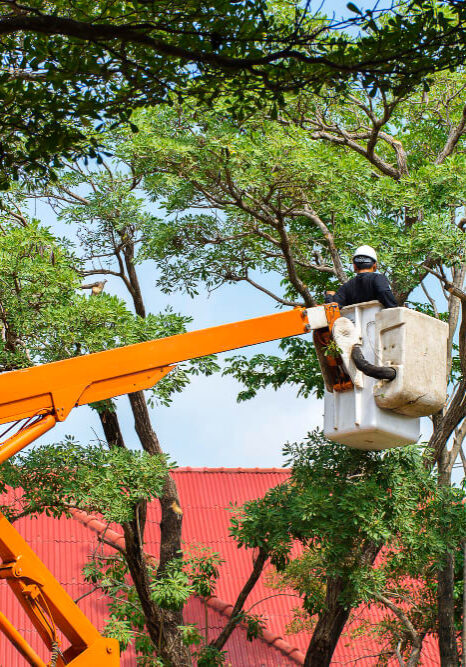
The work itself usually unfolds in stages. First, the crew establishes a safe work zone and protects sensitive surfaces if needed. Plywood or mats may be placed over lawn, irrigation, or decorative stone. Then the climber or aerial operator gains access to the canopy and begins removing peripheral brush. In narrow spaces, taking the outer growth first creates working room and improves sightlines.
Once the canopy is reduced, larger wood is dismantled in controlled sections. Depending on the site, pieces may be hand-lowered with ropes and friction devices, guided by tag lines, or lifted if crane access is available. Crane-assisted removals can be excellent for difficult residential sites, but only when there is enough access and room to operate safely. A crane is not automatically the best answer. In some neighborhoods, street setup, overhead wires, and tree position make traditional climbing and rigging more practical.
After the stem is down, the stump becomes its own decision point. Stump Removal & Grinding is often requested immediately, especially when the tree sat in a small yard where every square foot matters. Grinding is usually the more practical residential option because it avoids major excavation and reduces disturbance to surrounding roots, irrigation, and hardscape. Full stump removal may be necessary for construction, utility work, or certain replanting plans, but it is more invasive and often surprises homeowners with how much soil disruption it creates.
Signs a tree in a tight space needs urgent attention
Not every concern qualifies as an emergency, but some conditions should move a tree to the top of the schedule.
- Fresh cracks in the trunk or major limbs, especially after wind or heavy rain
- Sudden leaning with visible soil lifting or root plate movement
- Large dead sections over a home, driveway, or play area
- Split stems or hanging limbs caught in the canopy
- Contact or near-contact with service lines, structures, or access routes
A tree showing one of these signs may require Emergency Tree Services, particularly if occupancy or access is affected. Timing matters here. A compromised tree rarely becomes easier to deal with by waiting through another storm cycle.
Emergency work in confined residential settings
Emergency removals are their own category because time pressure changes the work environment. Storm damage often leaves crews dealing with partial failures, suspended limbs, twisted wood fibers, and loaded branches under tension. These jobs are dangerous even in open areas. In a fenced backyard or over a roofline, they demand extra discipline.
Homeowners sometimes want crews to move fast enough to restore normal life immediately, especially when a driveway is blocked or a bedroom roof has taken a hit. The best Emergency Tree Services balance urgency with method. The priority is stabilizing the site, preventing further failure, and restoring safe access. Full cleanup and finish work may come after the immediate hazard is controlled.
A common example is a storm-broken conifer with the top folded into a neighboring canopy above a detached garage. It looks as if a few cuts should solve it. In reality, the broken section may be bound under heavy compression, and releasing it incorrectly can cause violent movement. In a tight setting, experienced crews reduce weight gradually, reposition lines as the tree relaxes, and avoid assumptions based on how the failure looks from the ground.
Cost factors homeowners should understand
The cost of residential tree removal in difficult spaces depends less on raw size than on complexity. Height matters, but so do spread, species, condition, access, disposal volume, and target exposure. If the crew needs specialized rigging, extra climbers, traffic control, crane support, or repeated hand-carrying through limited access, labor climbs quickly.
Homeowners often compare estimates and focus only on the bottom line. That is understandable, but tight-space removals are not the place to buy the cheapest promise. If one estimate is dramatically lower, ask how the company plans to protect the house, fence, paving, and neighboring property. Ask whether stump grinding is included, whether debris haul-away is complete, whether the quote allows for difficult access, and whether the company is insured for the work being performed.
The price also reflects cleanup standards. Some companies leave rounds stacked neatly by the curb and call that complete. Others include full debris removal, rake-out, sawdust management, and cut-to-grade stump grinding. Neither approach is inherently wrong if it is clearly stated, but assumptions create disputes. The tighter the site, the more important those details become.
What homeowners can do before the crew arrives
Preparation will not change the technical difficulty of the job, but it can make the day smoother and reduce delays.
- Clear vehicles from driveways and curb space if the company needs chipper or truck access
- Move patio furniture, grills, planters, and fragile yard items out of the work corridor
- Keep children and pets indoors or off-site during active removal
- Identify irrigation lines, septic components, or hidden landscape lighting near the tree
- Confirm whether wood should be hauled away, stacked, or cut for firewood
These are small steps, but on narrow properties they matter. One parked SUV in the wrong place can turn a clean debris path into a bottleneck. One unmarked drip line can lead to avoidable damage during stump grinding.
The relationship between pruning, mitigation, and future removals
Many removals in tight spaces are the end result of years of deferred maintenance. That is not a criticism, just a pattern. A tree starts manageable, then grows into service lines, shades a roof, crowds a foundation planting, and develops long unbalanced laterals. By the time the canopy is scraping shingles and the trunk is too large for the site, the options are fewer.
Routine Tree Pruning & Crown Shaping can delay or even prevent that outcome for the right tree in the right place. It cannot make an oversized species stay small forever, but it can preserve structure, reduce defect development, and prevent clearance issues from becoming structural problems. The best pruning in residential settings often looks subtle. The tree still resembles itself. It simply fits the site better.
Wildfire Mitigation Tree Services overlap with this long-term view as well. In areas exposed to seasonal fire risk, selective pruning, removal of dead material, crown separation, and strategic thinning around structures can improve safety while preserving key shade trees. Homeowners sometimes assume wildfire mitigation means stripping a landscape bare. In practice, effective mitigation is more nuanced. It is about spacing, species behavior, fuel continuity, and access for suppression, not panic cutting.
Choosing the right company for difficult-space work
Skill in residential removals is not evenly distributed across the industry. A company that handles routine open-yard removals well may not be the best fit for confined technical work. The questions you ask should reflect that difference.
Ask who will assess the tree and who will supervise the job. Ask whether the crew routinely performs rope rigging over structures. Ask if they use climbers, aerial lifts, cranes, or a mix depending on the site. Ask what protection they place on lawns and hardscape. If the tree is compromised, ask how they evaluate climbing safety and what changes if the wood is unsound.
A good answer tends to sound specific rather than flashy. Experienced professionals talk about tie-in points, access routes, rigging loads, drop zones, and site protection. They mention trade-offs. They do not guarantee that difficult jobs are easy. They explain how they manage them.
This is also where a Certified Arborist Consultation can be useful even if you already expect removal. It helps separate emotional urgency from actual risk. It can confirm whether the tree is truly failing, whether support systems like Tree Cable and Bracing are viable, and whether selective pruning could buy time. When removal is the right answer, that consultation often leads to a cleaner, safer plan.
Why stump decisions should be made early
In small residential landscapes, the stump is more than an afterthought. It affects replanting, fence replacement, patio expansion, drainage, and basic use of the yard. Yet many homeowners decide about the stump only after the tree is gone, when equipment access is already limited by debris movement or when they discover the stump sits closer to utilities than expected.
Stump Removal & Grinding should be discussed during the estimate. A grinder needs access width, turning room, and a clear understanding of underground risks. In tight spaces, the machine used may be much smaller than the one used on open commercial sites, which affects speed and sometimes final depth. If roots have lifted adjacent pavers or crossed beneath a lawn irrigation manifold, the contractor should set realistic expectations about what grinding can and cannot solve.
Grinding usually leaves a mound of chips mixed with soil. In a visible front yard, some homeowners want those removed and replaced with clean topsoil. Others prefer to keep the mulch on site. There is no universal right choice, but deciding ahead of time helps the crew finish the area the way you intend to use it.
The quiet value of experience
The most impressive tree work often looks uneventful. That is the point. A difficult backyard removal done well is almost boring to watch. Pieces come down under control. The ropes stay organized. The climber moves deliberately. The ground crew clears the landing zone before it clutters. At the end of the day, the tree is gone, the fence is intact, and the yard looks better than a homeowner expected after such a complicated operation.
That result usually comes from experience more than bravado. It comes from knowing when a limb will swing, how dead wood behaves under hinge pressure, when to change rigging points, and when a tree that looked climbable during the estimate no longer deserves that assumption on the day of work.
Residential tree removal in tight and difficult spaces is not simply about taking down wood. It is about protecting homes, landscapes, and people while solving a problem that often sits at the center of a property. Whether the answer involves full Tree Removal Services, targeted Tree Pruning & Crown Shaping, Dangerous Tree Assessment and Removal, Emergency Tree Services, Tree Cable and Bracing, Wildfire Mitigation Tree Services, or a follow-up plan for Stump Removal & Grinding, the right approach is always site-specific.
That is what homeowners should expect from true professionals. Not a one-size-fits-all pitch, but a careful plan shaped by the tree, the space, and the risks that come with both.
Name: Ace Tree Services Ltd.
Address: 4656 Wallace Hill Rd, Kelowna, BC V1W 4C2, Canada
Phone: 250-212-9593
Website: https://acetree.ca/
Email: [email protected]
Hours:
Sunday: Closed
Monday: 7:00 AM–5:00 PM
Tuesday: 7:00 AM–5:00 PM
Wednesday: 7:00 AM–5:00 PM
Thursday: 7:00 AM–5:00 PM
Friday: 7:00 AM–5:00 PM
Saturday: 7:00 AM–5:00 PM
Time zone: Pacific Time
Open-location code / Plus code: RHF8+8G Kelowna, British Columbia, Canada
Map/listing URL: https://www.google.com/maps/search/?api=1&query=Google&query_place_id=ChIJxRVIBx2LfVMRNRSkp6-IC0U
Embed iframe:
Socials:
https://www.facebook.com/p/Ace-Tree-Services-61585901931447/
Ace Tree Services Ltd. provides professional tree care from its Kelowna location on Wallace Hill Road.
The official website lists tree removal, stump removal and grinding, tree pruning and crown shaping, emergency tree services, certified arborist consultation, dangerous tree assessment and removal, tree cabling and bracing, and wildfire mitigation.
Ace Tree Services serves homeowners, businesses, and property owners in Kelowna and throughout the Okanagan Valley.
The company’s official site highlights ISA Certified Arborist support, local Okanagan experience, and fully insured tree service work.
Customers can contact Ace Tree Services for planned tree maintenance, high-risk removals, storm-related tree concerns, pruning, stump grinding, and arborist consultation needs.
The supplied public listing address is 4656 Wallace Hill Rd, Kelowna, BC V1W 4C2, near rural and residential service areas in southeast Kelowna.
For tree services in Kelowna and the Okanagan, call 250-212-9593, email [email protected], or visit https://acetree.ca/
The public map listing uses plus code RHF8+8G Kelowna, British Columbia, Canada and can help customers find Ace Tree Services Ltd. near Wallace Hill Road.
Popular Questions About Ace Tree Services Ltd.
What does Ace Tree Services Ltd. do?
Ace Tree Services Ltd. provides tree removal, stump removal and grinding, tree pruning and crown shaping, emergency tree service, certified arborist consultation, dangerous tree assessment and removal, tree cabling and bracing, and wildfire mitigation.
Where is Ace Tree Services Ltd. located?
Ace Tree Services Ltd. is listed at 4656 Wallace Hill Rd, Kelowna, BC V1W 4C2, Canada.
What phone number should customers call?
Customers can call Ace Tree Services Ltd. at 250-212-9593.
What is the email address for Ace Tree Services Ltd.?
The supplied email address is [email protected].
What are Ace Tree Services Ltd.’s hours?
The supplied listing hours show Monday through Saturday from 7:00 AM to 5:00 PM, with Sunday closed, Pacific Time. The official website lists 7:00 AM to 5:00 PM, Monday through Friday, so customers should confirm Saturday availability before booking.
Does Ace Tree Services Ltd. provide emergency tree service?
Yes. The official website lists emergency tree services, including emergency tree removal, dangerous tree assessment, emergency stabilization, and limb or branch cleanup.
Does Ace Tree Services Ltd. offer arborist consultations?
Yes. The official services page lists certified arborist consultation as one of the company’s Okanagan tree services.
Does Ace Tree Services Ltd. provide stump grinding?
Yes. The official services page lists stump removal and grinding as a service.
What areas does Ace Tree Services Ltd. serve?
The official website states that Ace Tree Services serves Kelowna and the Okanagan Valley.
How do I contact Ace Tree Services Ltd.?
Call 250-212-9593, email [email protected], visit https://acetree.ca/, or use the listed social profile: Facebook.
Landmarks Near Kelowna, BC
Wallace Hill Road: The road listed for Ace Tree Services Ltd. and a practical reference point for the company’s Kelowna location.
East Kelowna: A nearby rural and residential area where tree maintenance, pruning, removals, and wildfire mitigation can be important for property owners.
Myra-Bellevue Provincial Park: A major outdoor landmark southeast of Kelowna and a useful reference for the surrounding hillside and forested areas.
Gallagher’s Canyon: A nearby Kelowna community with residential properties, mature trees, and landscape maintenance needs.
Kettle Valley: A southeast Kelowna neighborhood with homes, parks, and landscaped properties.
Mission Creek Greenway: A well-known natural corridor in Kelowna and a local reference point for tree-lined recreation areas.
Orchard Park Shopping Centre: A major Kelowna retail landmark and citywide reference point.
Downtown Kelowna: A central business and residential district within Ace Tree Services’ broader Kelowna service area.
Okanagan Lake: A major regional landmark running through Kelowna and the surrounding Okanagan Valley.
Mission Creek Regional Park: A recognizable Kelowna park and natural landmark with extensive trees and trails.
Rutland: A large Kelowna community with residential and commercial properties that may need tree service support.
Glenmore: A Kelowna neighborhood with homes, parks, and established trees.
Lower Mission: A residential and lake-adjacent Kelowna area where pruning, tree health, and property safety can matter for homeowners.
Kelowna International Airport: A major transportation landmark north of central Kelowna.
West Kelowna: A nearby Okanagan community across the lake and a practical regional service reference.
For tree removal, stump grinding, pruning, crown shaping, emergency tree service, arborist consultation, dangerous tree assessment, cabling and bracing, or wildfire mitigation near these Kelowna and Okanagan landmarks, contact Ace Tree Services Ltd. at 250-212-9593, email [email protected], or visit https://acetree.ca/