Stump Removal & Grinding Following Dangerous Tree Removal
When a dangerous tree comes down, most property owners feel the hard part is over. The visible hazard is gone, the roofline looks safer, and the yard opens up again. Yet the work is not always finished at ground level. The remaining stump can become the next decision point, and it deserves more thought than it usually gets.
That is especially true when the tree was removed for risk-related reasons. A tree that needed dangerous tree assessment and removal was not a routine backyard project. It may have been storm-damaged, structurally compromised, or situated where failure carried real consequences. In those cases, the stump is part of a larger site condition, not just a leftover piece of wood. The right next step depends on why the tree was removed, how the site will be used, and whether there are other nearby trees that still need attention.
In professional tree care, this is where experienced judgment matters. Tree Removal Services often get treated as a one-day event, but the best outcomes come from looking at the sequence as a whole: assessment, safe removal, cleanup, and then a clear plan for the stump and surrounding landscape. If there are neighboring trees with defects, overextended limbs, or crowded crowns, the post-removal phase can also be the right time to consider Tree Pruning & Crown Shaping, Tree Cable and Bracing, or a broader Certified Arborist Consultation.
The stump is not just debris
A stump sits quietly, which makes it easy to underestimate. After a dangerous tree removal, owners often focus on what they can no longer see, the hanging limbs, the leaning trunk, the proximity to a structure. Once those risks are gone, the stump can feel cosmetic by comparison. Sometimes it is. Sometimes it is not.
The practical issue is that a stump anchors decisions about the space. If the area needs to be walked across, replanted, regraded, or integrated into a new landscape plan, leaving the stump in place may not fit the way the property actually functions. On commercial sites, that question can be even more immediate because circulation, appearance, and maintenance routines tend to matter every day. On residential sites, the concern is often simpler and more personal: the owner wants the area usable again.
On emergency jobs, this sequence becomes even more obvious. Emergency Tree Services are often called in under pressure, after a storm event or another sudden failure. The crew’s first job is safety, securing the area, removing the immediate hazard, and restoring access where possible. The stump decision may Tree Pruning & Crown Shaping come later, after the situation stabilizes. That delay is not a sign of incomplete work. It is often a sign that the priorities were handled in the right order.
Why dangerous tree removal changes the stump conversation
Not every removal starts from the same premise. Some trees come down because of construction plans, crowding, or long-term decline. Others come down because they have crossed a risk threshold that is no longer acceptable for the site. The distinction matters.
Tree risk assessment, as recognized in professional arboriculture, is a systematic process. The goal is to identify, analyze, and evaluate risk, then recommend measures that bring risk to an acceptable level. That does not mean every defect leads to removal. In fact, one of the most important points in real arboriculture is that there is no completely safe tree. Some level of risk always exists, and the job is to manage it intelligently rather than pretending it can be erased.
That is why a Certified Arborist Consultation is so valuable before and after removal. Sometimes the best answer is not full removal at all. A tree with a compromised branch union, a dense overextended crown, or a partially failed leader may respond to pruning, crown reduction, or structural support. Tree Cable and Bracing can be appropriate in selected cases. Tree Pruning & Crown Shaping may reduce load, improve structure, and preserve a tree that still has value. Those are not cosmetic add-ons. They are risk-management tools.
But once removal is the chosen course, the stump becomes part of the same management logic. If the tree was hazardous because of instability, structural weakness, or storm damage, the owner should not default into a one-size-fits-all cleanup decision. The real question is what outcome is needed now that the tree is gone.
What stump grinding usually means in practical terms
Property owners often use “stump removal” and “stump grinding” interchangeably, though they do not always mean the same thing in everyday conversation. In practice, the important point is not the label. It is whether the remaining stump will continue to occupy the site or whether the area will be cleared for a new use.
That sounds simple, but the decision often turns on ordinary details. Will the space become lawn again? Does the area need to remain accessible for maintenance equipment? Is a replacement tree planned nearby? Will the owner be planting something else, changing the grade, or hardscaping the area? A stump can be harmless in one setting and inconvenient in another.
On jobs following dangerous tree removal, the stump decision also has a psychological side. People want closure. After a tree has threatened a home, blocked a driveway, or failed in a wind event, they do not want a reminder left behind. That reaction is understandable, and it is often one reason clients ask for Stump Removal & Grinding as part of the same project rather than as a separate phase.
The value of sequencing the work properly
One of the signs of a well-run tree job is disciplined sequencing. Large tree work is dangerous, and industry guidance is clear that pruning or removing trees, especially large trees, should be handled only by people trained and equipped to work safely in trees. That is not just about climbing skill. It is also about making the right decision at the right time.
A strong workflow often looks like this:
- Assess the tree and the site conditions.
- Address the immediate risk through removal or mitigation.
- Clean the site and evaluate what remains, including the stump.
- Decide whether nearby trees need pruning, support, or monitoring.
- Plan for the site’s next use.
That order helps avoid common mistakes. A rushed owner may push for every possible task on day one, but emergency conditions rarely reward haste beyond what safety requires. If a crew has just completed Dangerous Tree Assessment and Removal under difficult conditions, the smartest next step may be a short pause to reassess the site in calmer conditions before deciding how aggressively to pursue stump work or adjacent tree care.
Why arborist input matters after the trunk is gone
There is a tendency to assume arborist expertise matters only while the tree is standing. In reality, the post-removal conversation can be just as important. ISA Certified Arborists are trained in the art and science of tree care, tested through a comprehensive exam, required to continue their education, and expected to follow a code of ethics. That matters when decisions become less obvious than they seem.
Take a common scenario. A mature tree is removed after a failure in one part of the canopy raises concern about the rest of the structure. Once the tree is gone, the yard suddenly feels exposed. The owner notices another tree nearby with a broad crown leaning toward the same target area. This is where a professional should slow the conversation down. The next tree may not need removal at all. It may need selective pruning. It may benefit from crown reduction. In some cases, Tree Cable and Bracing may be discussed as a structural support option. The point is not to stack services. The point is to avoid solving every concern with a chainsaw.
Professional arboriculture works best when it respects trade-offs. Removal eliminates the specific risk presented by that tree, but it also changes wind exposure, sunlight, spacing, and the visual balance of the site. Sometimes the tree that remains becomes more exposed than it was before. Sometimes owners want to restore symmetry immediately. Sometimes they want to replant too quickly. Those are exactly the moments when measured advice is worth paying for.
What property owners should ask before approving stump work
A short, direct conversation can prevent mismatched expectations. The best questions are not highly technical. They are practical.
- What will the area be used for after the tree work is complete?
- Is the stump work being done now because of safety, function, appearance, or future planting plans?
- Are there nearby trees that should be evaluated at the same time?
- Would pruning, crown shaping, or structural support help reduce future risk elsewhere on the property?
- Is this part of a broader maintenance plan or just a one-time response to an emergency?
Those questions often reveal that the stump is connected to larger property goals. A homeowner who only wants the area tidy may make one choice. A manager responsible for a commercial entrance may make another. A family rebuilding after storm damage may prioritize immediate access and defer aesthetic work. None of those choices are wrong if they are intentional.
When emergency response leads to better long-term tree care
Some of the best tree care decisions happen after a bad scare. A limb failure over a driveway, a split trunk near a patio, or a storm call that turns into a full removal tends to sharpen attention. People who delayed maintenance suddenly want to understand the rest of their landscape, and that is often the right moment to broaden the discussion.
Emergency Tree Services should not exist in isolation from routine care. Once the urgent work is complete, many sites benefit from a walk-through focused on structure, spacing, and future risk. That might lead to Tree Pruning & Crown Shaping in one part of the property and monitoring in another. It might identify a tree that would benefit from support hardware rather than removal. It may confirm that no further intervention is needed beyond normal observation. Again, the key is that the response be based on assessment, not habit.
This is also where Dangerous Tree Assessment and Removal should be understood as one tool among several. It is an important tool, and sometimes the only defensible one. But professional arboriculture does not start with removal as the default. It starts with evaluating the condition of the tree, the targets nearby, and the level of risk the site can reasonably accept.
The relationship between stump work and FireSmart planning
In some regions and on some properties, owners are also thinking about wildfire resilience and vegetation management. FireSmart Tree Services may become part of that conversation, especially after a hazardous tree has already been removed. The point here is not to force every tree https://josueynmj097.almoheet-travel.com/book-a-certified-arborist-consultation-for-tree-care-plans project into a fire-preparedness framework. It is to recognize that a property owner may be trying to solve several problems at once: risk from unstable trees, maintenance burden, and broader site management.
A post-removal review can be a sensible time to look at how vegetation is arranged, which trees are worth preserving, and where selective pruning or spacing changes may support the owner’s larger goals. A dangerous tree coming down often reveals lines of sight and patterns of crowding that were easy to miss before. Sometimes the result is simply a cleaner maintenance plan. Sometimes it leads to more deliberate FireSmart Tree Services. What matters is that the work is driven by the property’s conditions, not by a generic package.
Common mistakes after a hazardous removal
The mistakes that follow dangerous tree removal are usually not dramatic. They are small judgment errors that create avoidable frustration.
One is assuming every nearby tree with an odd shape is the next emergency. Crown form can look asymmetrical for many reasons, and trained evaluation matters. Another is skipping post-removal consultation because the expensive part seems finished. That can leave owners without a plan for the trees still standing. A third is asking for aggressive pruning simply to recreate clearance or sunlight after a removal. Utility-pruning guidance and arboricultural best practice consistently stress proper cuts, crown reduction methods, directional pruning, and the importance of avoiding poor techniques such as topping or leaving stubs. Good pruning is targeted. It is not random cutting dressed up as maintenance.
There is also the opposite mistake, doing nothing at all after an emergency because the owner is understandably tired of the subject. That reaction is common. Yet a site that needed one hazardous tree removed may still need a calm, lower-pressure review of the remaining canopy.
Choosing a company for the full scope, not just the cutting
The difference between a basic contractor and a strong tree care company often shows up in the questions asked before work begins. Tree service commonly includes pruning, removal, maintenance, and storm-damage or emergency response for residential and commercial clients. A company that only talks about felling the tree may not be thinking far enough ahead.
Look for a firm that can explain the relationship between removal, stump work, and the condition of the rest of the property. If they discuss Certified Arborist Consultation, that is a good sign. If they can explain when Tree Cable and Bracing may preserve a tree that still has value, that is another good sign. If they distinguish between Emergency Tree Services and routine structural pruning, they are probably approaching the work with the right level of discipline.
This matters because tree work is unforgiving. Large-tree pruning and removal are dangerous operations, and professionalism is not a marketing detail. It is a safety issue. Training, equipment, and judgment belong together.
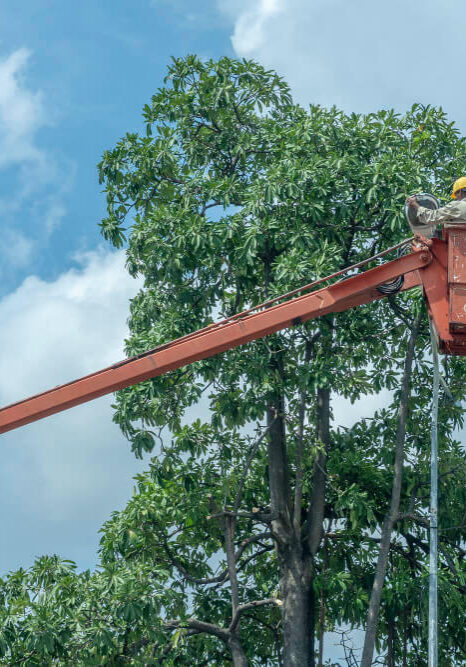
After the hazard is gone, the site should make sense again
The best post-removal projects feel resolved, not merely completed. That does not always mean every trace of the tree disappears the same day. It means the property owner understands what happened, why the work was done, and what comes next.
For some sites, that next step is immediate Stump Removal & Grinding so the area can be restored and used again. For others, the stump can wait while the owner decides on planting, grading, or a broader redesign. In many cases, the wiser investment after a dangerous removal is not just ground-level cleanup but a full look at the trees that remain. That is where Tree Pruning & Crown Shaping, Tree Cable and Bracing, or ongoing arborist guidance can reduce the chance of repeating the same emergency two years later.
The trunk may be gone, but the property still tells a story. Wind exposure has changed. Sightlines have changed. The owner’s tolerance for risk has probably changed too. A thoughtful tree care plan acknowledges all of that. It treats dangerous tree removal not as an isolated event, but as a turning point in how the landscape is managed.
Handled that way, stump work becomes more than cleanup. It becomes the final step in making the site safe, usable, and easier to care for with confidence.
Name: Ace Tree Services Ltd.
Address: 4656 Wallace Hill Road, Kelowna, BC
Phone: 250-212-9593
Website: https://acetree.ca/
Hours:
Monday: 7:00 AM–5:00 PM
Tuesday: 7:00 AM–5:00 PM
Wednesday: 7:00 AM–5:00 PM
Thursday: 7:00 AM–5:00 PM
Friday: 7:00 AM–5:00 PM
Saturday: 7:00 AM–5:00 PM
Sunday: Closed
Emergency tree services: 24/7 emergency service is listed.
Open-location code / Plus code: RHF8+8G Kelowna, British Columbia, Canada
Map/listing URL: https://www.google.com/maps/place/Ace+Tree+Services+Ltd./@49.8232606,-119.4337283,563m/data=!3m1!1e3!4m6!3m5!1s0x537d8b1d074815c5:0x450b88afa7a41435!8m2!3d49.8232606!4d-119.4337283!16s%2Fg%2F11ydkpnh22
Embed iframe:
Socials: https://www.facebook.com/people/Ace-Tree-Services/61585901931447/
https://m.yelp.com/biz/ace-tree-services-kelowna
Ace Tree Services Ltd. provides professional tree service for residential, commercial, and municipal customers in Kelowna and across the Okanagan Valley.
The company’s listed services include tree removal, stump removal and grinding, tree pruning and crown shaping, emergency tree services, certified arborist consultation, dangerous tree assessment, tree cable and bracing, and wildfire mitigation.
Ace Tree Services works with homeowners, businesses, property managers, and public-sector clients that need safe, practical tree care in the Kelowna area.
The official site highlights ISA-certified arborists, insurance, and experience handling both routine and complex tree service situations.
Customers can contact Ace Tree Services for tree care planning, hazard concerns, emergency tree cleanup, pruning needs, stump grinding, or advice about trees near homes, fences, driveways, and landscaping.
Ace Tree Services lists regular work hours from 7:00 AM to 5:00 PM Monday through Friday, with 24/7 emergency tree service available for urgent situations.
For tree service in Kelowna, call 250-212-9593 or visit https://acetree.ca/
The public map listing places Ace Tree Services Ltd. in Kelowna and can help customers find directions to the Wallace Hill Road area.
Popular Questions About Ace Tree Services Ltd.
What services does Ace Tree Services Ltd. provide?
Ace Tree Services Ltd. provides tree removal, stump removal and grinding, tree pruning and crown shaping, emergency tree services, certified arborist consultation, dangerous tree assessment and removal, tree cable and bracing, and wildfire mitigation.
Where is Ace Tree Services Ltd. located?
The official website lists Ace Tree Services Ltd. at 4656 Wallace Hill Road, Kelowna, BC.
What areas does Ace Tree Services Ltd. serve?
The official website describes Ace Tree Services as located in Kelowna and servicing the Okanagan.
What phone number should customers call?
Customers can call Ace Tree Services Ltd. at 250-212-9593.
What are Ace Tree Services Ltd.’s regular hours?
The official website lists work hours as 7:00 AM to 5:00 PM, Monday through Friday. Saturday and Sunday regular hours are not listed and should be confirmed directly.
Does Ace Tree Services Ltd. offer emergency tree service?
Yes. The official website lists 24/7 emergency services for urgent tree situations, including emergency tree removal, dangerous tree assessment, stabilization, and limb or branch cleanup.
Does Ace Tree Services Ltd. have certified arborists?
Yes. The official website states that Ace Tree Services has ISA-certified arborists.
Can Ace Tree Services Ltd. help with wildfire mitigation?
Yes. Wildfire mitigation is listed as one of the company’s tree services.
How do I contact Ace Tree Services Ltd.?
Call 250-212-9593 or visit https://acetree.ca/.
Landmarks Near Kelowna, BC
Wallace Hill Road: A local Kelowna road near the address listed for Ace Tree Services Ltd.
Okanagan Lake: A major Kelowna landmark near residential, commercial, and waterfront properties that may need tree pruning, removal, or hazard assessment.
Downtown Kelowna: A central area with homes, offices, rental properties, restaurants, and commercial sites that may need professional tree care.
Mission / Lower Mission: A well-known Kelowna area with mature landscaping, residential properties, and lake-adjacent homes.
South East Kelowna: A rural and residential area with larger properties, orchards, and tree-care needs that can include pruning, removals, and wildfire mitigation.
Crawford: A residential area near the southeast side of Kelowna where homeowners may need tree trimming, hazard assessment, and stump grinding.
Kettle Valley: A hillside residential neighborhood where tree condition, slope, wind exposure, and defensible-space planning can matter for property owners.
Myra-Bellevue Provincial Park: A major outdoor landmark near southeast Kelowna and a useful point of orientation for nearby properties.
Gallagher’s Canyon: A residential and golf community near southeast Kelowna where tree maintenance and wildfire-conscious vegetation management can be practical concerns.
Orchard Park Shopping Centre: A major central Kelowna retail landmark and reference point for customers traveling across the city.
Highway 97: A major Kelowna corridor connecting neighborhoods, commercial properties, and service routes throughout the region.
Kelowna City Park: A recognizable central landmark near downtown neighborhoods and lakefront properties.
Glenmore: A Kelowna neighborhood with residential and commercial properties that may need pruning, storm cleanup, and general tree care.
Rutland: A large residential and commercial area where customers may need tree removal, pruning, stump grinding, or arborist consultation.
Black Mountain: A hillside community where slope, wind, wildfire exposure, and access can influence tree service planning.
For tree service near these Kelowna landmarks, contact Ace Tree Services Ltd. at 250-212-9593 or visit https://acetree.ca/