Tree Pruning & Crown Shaping for Better Tree Management
A well-managed tree rarely calls attention to itself. It shades a driveway without scraping the roofline. It frames a front yard without swallowing the windows. It moves in the wind as it should, with a crown that looks balanced because the structure behind it is balanced. That kind of result does not happen by accident. It comes from careful Tree Pruning & Crown Shaping, done with a clear purpose and with respect for how the tree grows.
People often think of pruning as cosmetic work, and sometimes it is Tree Pruning & Crown Shaping partly aesthetic. A shaped crown can absolutely improve the appearance of a landscape. But the real value runs deeper. Pruning can support structure, manage conflicts with built spaces, reduce certain kinds of failure potential, and help a tree coexist with the demands of a property. It can also reveal when pruning is no longer the right answer, and when a broader discussion about Dangerous Tree Assessment and Removal, Tree Cable and Bracing, or even Tree Removal Services is more responsible.
That is where professional judgment matters. Tree care is not just about what can be cut. It is about what should be cut, what should remain, and what problem the work is actually trying to solve.
Pruning with a goal, not a habit
The strongest pruning plans start with a question: what are we trying to achieve? On one property, the goal may be crown clearance over a driveway. On another, it may be selective reduction to reduce end weight on a long lateral branch. In a dense residential setting, the objective may be to improve separation between a mature tree and a house without leaving the crown misshapen or stressed.
Those distinctions matter because different cuts create different outcomes. Raising a crown is not the same as reducing it. Thinning is not the same as reshaping. Reduction cuts require judgment about branch size, growth habit, and long-term form. Poor cuts, especially stub cuts or indiscriminate heading, can create more problems than they solve. The tree may respond with weakly attached shoots, uneven regrowth, or a form that requires repeated corrective work.
Topping is one of the clearest examples of bad intent disguised as maintenance. It may seem fast, and at first glance it looks decisive, but it ignores how trees compartmentalize wounds and distribute growth. A topped tree can become uglier, more maintenance-heavy, and potentially less stable over time. A well-executed crown reduction, by contrast, aims to preserve the natural outline as much as possible while shortening selected branches back to appropriate lateral growth.
Good pruning is precise. It reads the tree first.
What crown shaping really means
Crown shaping is sometimes misunderstood as sculpting a tree into whatever profile a client prefers. In practice, professional crown shaping is more restrained. The goal is usually to improve proportion, reduce imbalance, manage site conflicts, and preserve the species’ natural habit as much as the setting allows.
That balancing act is where experience shows. A tree leaning slightly over a garden bed may be entirely acceptable if its structure is sound and targets are limited. The same lean over a play area, parked vehicles, or a roof deserves a more serious look. Shape alone does not define risk, but crown form can reveal underlying structural concerns. Heavy lateral extension, co-dominant stems, long overextended limbs, and asymmetrical loading are all reasons to slow down and evaluate before making cuts.
Shaping also needs to account for what the tree has endured already. A tree that has been over-pruned in the past may have a thin interior canopy and dense outer growth. Another may have old storm damage that altered how the crown carries weight. In those cases, the work is rarely about creating a textbook silhouette. It is about improving function without asking the tree to recover from another round of unnecessary stress.
Better management starts before the first cut
One of the most valuable parts of a pruning project happens on the ground, before anyone climbs or sets a rope. The inspection sets the entire tone of the work. You are looking at branch unions, crown density, deadwood, previous pruning wounds, proximity to structures, and signs that the issue might be larger than crown shaping alone.
This is often where a Certified Arborist Consultation makes the difference. ISA Certified Arborists are trained in the art and science of tree care, they pass a comprehensive exam, continue their education, and work under a code of ethics. That matters because the decision is not simply whether a branch can be removed safely. The deeper question is whether pruning is the correct treatment at all.
Tree risk is not a yes-or-no label. There is no completely safe tree, and some level of risk is always part of living around trees. A proper assessment is systematic. It identifies the concern, analyzes likely outcomes, and evaluates whether risk can be reduced to an acceptable level through treatment. Sometimes the recommendation is selective pruning. Sometimes it is structural support. Sometimes it is monitoring. And sometimes the honest answer is that Dangerous Tree Assessment and Removal is the more defensible path.
That is not alarmism. It is disciplined decision-making.
The difference between maintenance pruning and risk mitigation
Routine maintenance and risk-focused pruning can overlap, but they are not the same thing. A homeowner may call for shape improvement and discover during the visit that a large limb has included bark at the union, old storm damage, or decay near a previous wound. Suddenly the work is no longer about appearance first. It is about whether weight reduction, clearance, or support can lower the chance of failure in a meaningful way.
This distinction matters because clients often want certainty where none exists. Tree risk can be reduced, but not erased. An arborist can recommend treatments that improve the situation without promising a zero-risk outcome. That is a more professional message than overselling aggressive cutting.
A common mistake is assuming that removing more canopy always makes a tree safer. It can, in some situations, reduce loading on specific limbs. But over-thinning or excessive removal can also change wind exposure, trigger undesirable regrowth, or weaken the tree’s overall condition. Good management asks what kind of reduction is useful, where it belongs, and how much the tree can tolerate.
When support systems belong in the conversation
Pruning is not always enough on its own. Some trees benefit from Tree Cable and Bracing as part of a broader management plan, especially when the concern involves structural weakness that pruning alone cannot address. The principle is straightforward: support systems may help mitigate certain structural issues, but they are not decorative add-ons and they do not excuse poor pruning.
A thoughtful recommendation might combine limited reduction on long, end-weighted branches with a support system for a vulnerable union. Another case may call for continued observation after the work is complete. That layered approach is often better than choosing between extremes, either doing nothing or removing a major tree too quickly.
Still, support has to fit the biology and the risk profile of the tree. Not every weak-looking branch deserves hardware, and not every mature specimen can be justified for retention if the defects are significant and the targets are serious. This is exactly why one-size-fits-all pruning advice is so unreliable.
Seasonal pressure, storm damage, and urgent calls
Not all pruning requests arrive in calm conditions. After storms, tree crews are often dealing with split limbs, hanging branches, partially failed tops, and trees that have shifted enough to worry property owners. Emergency Tree Services are a different environment from scheduled maintenance work. The pace is faster, access can be worse, and the margin for error is smaller.
Emergency response in arboriculture is part of the broader standards framework used in professional tree care. The work may involve stabilizing a hazardous situation, removing failed material, or restoring access while preserving as much of the tree as reasonably possible. In these moments, pruning can be a tool for immediate hazard reduction, but emergency work is not the same as refined crown shaping. Sometimes it is triage.
Once the immediate danger has passed, the tree often needs a second look. A storm-broken crown can leave uneven loading, torn attachment points, and structural defects that were hidden before failure. What looked like a one-time cleanup can evolve into a more careful management decision: restore the crown through selective pruning, install support, monitor, or move toward removal.
The homeowners who make the best long-term decisions are usually the ones who understand that emergency work solves the urgent problem first, not the whole problem at once.
Signs that a pruning request needs a deeper assessment
Some site conditions should prompt a slower, more analytical approach before anyone commits to straightforward crown shaping.
- Large dead branches within the crown
- A tree that has already lost major limbs in past storms
- Noticeable imbalance over a house, driveway, or occupied area
- Old topping cuts or obvious improper pruning wounds
- Branch unions that appear weak, crowded, or heavily loaded
None of these automatically means removal. They do mean the tree deserves more than a quick price quote for trimming. A systematic look at risk and treatment options is the responsible next step.
How pruning decisions connect to removals and stump work
Tree Pruning & Crown Shaping sits in the middle of the larger tree care picture. On one end is preventive maintenance. On the other is removal. The transition between them is not always dramatic. Sometimes it happens after years of reasonable care, when the tree’s condition, location, or structural issues change the equation.
This is why reputable companies that provide Tree Removal Services often approach pruning carefully. They know that pruning can extend useful service life in some cases, but they also know when repeated cutting becomes a way of postponing an outcome that is already clear. If a tree requires heavy intervention every short cycle just to stay off a roof, sidewalk, or utility-adjacent space, it may be worth discussing whether retention still makes sense.
When a tree does come down, the conversation usually continues below grade. Stump Removal & Grinding is not part of pruning, but it often follows removal when the site needs to be replanted, graded, or simply cleared for use. Treating pruning, removal, and stump work as separate but connected services gives property owners a more coherent plan. It also avoids the common problem of making a crown-shaping decision in isolation, without considering what the site needs over the next five or ten years.
Fire exposure changes the priorities
In fire-prone areas, pruning goals can shift again. FireSmart Tree Services bring a different lens to crown management. The focus may include separation, removal of dead material where appropriate, and reducing certain fuel concerns around structures. Even then, the same principle applies: the work should be purposeful and informed, not indiscriminate.
A tree near a home in a fire-exposed zone may need thoughtful crown work that improves management around the structure without destroying the tree’s natural form. It may also reveal that one tree is maintainable while another is poorly placed and should be considered for removal. Fire-related management is a reminder that the “best” pruning plan is always site-specific. A treatment that makes sense in a park-like lot may not fit a narrow residential corridor, and what works in a low-risk landscape may be inappropriate where wildfire planning is part of routine property care.
What homeowners and property managers should ask before approving work
Pruning proposals are easier to trust when the purpose is clear and the language is specific. Vague promises of “cutting back” or “cleaning up” often hide weak planning. Better questions lead to better outcomes.
- What is the primary objective of the pruning?
- Are you recommending maintenance, risk reduction, or corrective shaping?
- Is a Certified Arborist Consultation appropriate before work begins?
- Could support systems such as Tree Cable and Bracing be part of the solution?
- If pruning is not enough, what would trigger Dangerous Tree Assessment and Removal?
These questions do not make a client difficult. They make the scope of work legible. That clarity protects both the tree and the property owner.
Why trained crews matter on larger trees
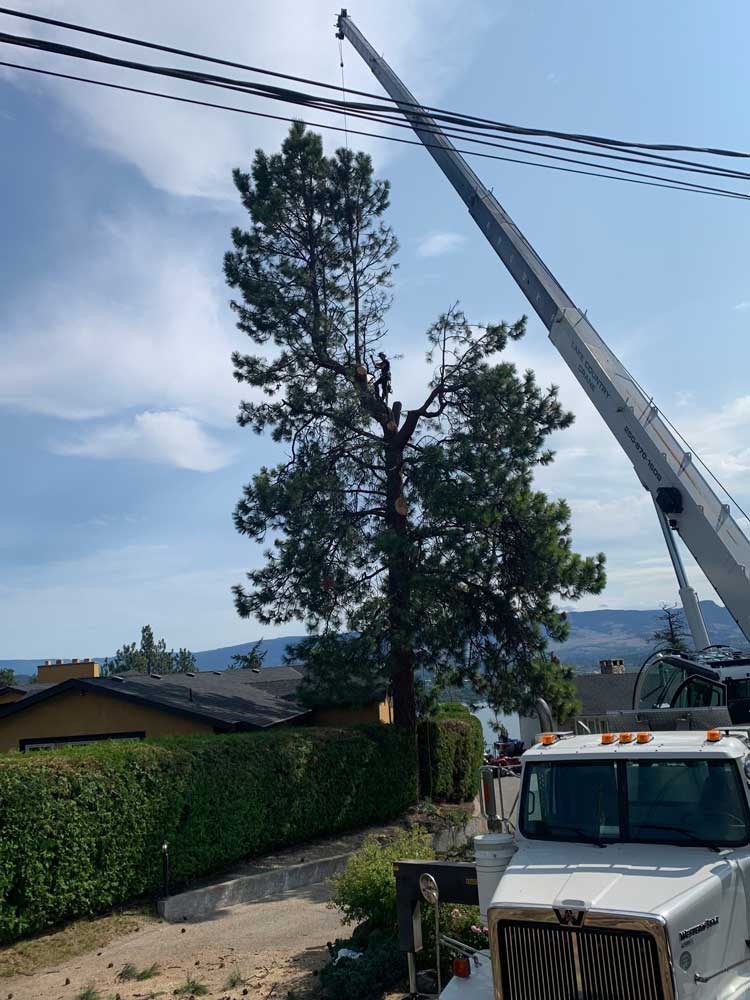
Large-tree pruning is not casual yard work. It is technical and potentially dangerous. Professional organizations in arboriculture have long emphasized that pruning or removing large trees should be handled only by people who are trained and equipped to work safely in trees. That point is easy to underestimate until a project involves rigging, controlled lowering, awkward branch angles, or brittle storm-damaged wood.
Even when the goal is modest, such as shortening selected limbs away from a structure, the execution can be demanding. A correct reduction cut may be several meters out from the trunk, above fences, roofs, planting beds, or other obstacles. The crew needs to move safely, protect the site, and lower material in a controlled way where free-fall is not acceptable.
There is also the less visible part of competence: knowing when not to cut. Skilled arborists recognize when access, defect patterns, or target conditions shift a routine pruning job into a higher-risk operation. They adjust the plan, the equipment, or the recommendation accordingly. That restraint is part of professionalism.
The visual result should not be the only measure
A freshly pruned tree can look tidy and still be poorly managed. In fact, some of the worst pruning jobs look dramatic in a way that briefly satisfies clients. The canopy is smaller, more light reaches the lawn, and the crew appears to have done a lot. But heavy-handed work can store up new issues: dense regrowth, exposed limbs, structural imbalance, or a cycle of repeated correction that gets more expensive over time.
A better measure is whether the tree still looks like itself after the work, only more functional. The crown should have a coherent form. The cuts should reflect clear intent. The branches that remain should still carry the structure and habit of the species as naturally as the site allows.
That is especially true in crown shaping. The best work is often subtle from the ground. A branch line is improved. Clearance is gained. Weight is reduced where it matters. The tree fits the space better, but it has not been carved into a generic shape.
Better management is cumulative
Tree care rarely succeeds as a one-time event. A mature tree on a developed property changes as the site changes. Structures age, use patterns shift, storms expose weaknesses, and earlier pruning decisions influence later ones. Better management comes from continuity, the kind that links inspection, pruning, support, emergency response, and removal decisions into a long-term view rather than treating each visit as unrelated.
That does not mean every tree needs constant intervention. Some https://charlienbvb913.theburnward.com/eco-friendly-stump-removal-grinding-options need very little. But it does mean that pruning should be part of a broader management mindset. If the only question asked is “How much can we cut today?” the result is usually short-sighted. If the question is “What does this tree need to remain appropriate for this site?” the work becomes more disciplined.
Tree Pruning & Crown Shaping, done well, is one of the most valuable tools in that process. It improves usability, supports structure, and helps retain trees that still have a sound future on the property. Just as importantly, it helps identify the cases where pruning is no longer enough, and where the more responsible path may involve Emergency Tree Services, Tree Cable and Bracing, a formal Certified Arborist Consultation, or carefully planned Tree Removal Services followed by Stump Removal & Grinding.
That is what better tree management looks like in practice. Not more cutting, and not less, but the right work for the tree in front of you.
Name: Ace Tree Services Ltd.
Address: 4656 Wallace Hill Road, Kelowna, BC
Phone: 250-212-9593
Website: https://acetree.ca/
Hours:
Monday: 7:00 AM–5:00 PM
Tuesday: 7:00 AM–5:00 PM
Wednesday: 7:00 AM–5:00 PM
Thursday: 7:00 AM–5:00 PM
Friday: 7:00 AM–5:00 PM
Saturday: 7:00 AM–5:00 PM
Sunday: Closed
Emergency tree services: 24/7 emergency service is listed.
Open-location code / Plus code: RHF8+8G Kelowna, British Columbia, Canada
Map/listing URL: https://www.google.com/maps/place/Ace+Tree+Services+Ltd./@49.8232606,-119.4337283,563m/data=!3m1!1e3!4m6!3m5!1s0x537d8b1d074815c5:0x450b88afa7a41435!8m2!3d49.8232606!4d-119.4337283!16s%2Fg%2F11ydkpnh22
Embed iframe:
Socials: https://www.facebook.com/people/Ace-Tree-Services/61585901931447/
https://m.yelp.com/biz/ace-tree-services-kelowna
Ace Tree Services Ltd. provides professional tree service for residential, commercial, and municipal customers in Kelowna and across the Okanagan Valley.
The company’s listed services include tree removal, stump removal and grinding, tree pruning and crown shaping, emergency tree services, certified arborist consultation, dangerous tree assessment, tree cable and bracing, and wildfire mitigation.
Ace Tree Services works with homeowners, businesses, property managers, and public-sector clients that need safe, practical tree care in the Kelowna area.
The official site highlights ISA-certified arborists, insurance, and experience handling both routine and complex tree service situations.
Customers can contact Ace Tree Services for tree care planning, hazard concerns, emergency tree cleanup, pruning needs, stump grinding, or advice about trees near homes, fences, driveways, and landscaping.
Ace Tree Services lists regular work hours from 7:00 AM to 5:00 PM Monday through Friday, with 24/7 emergency tree service available for urgent situations.
For tree service in Kelowna, call 250-212-9593 or visit https://acetree.ca/
The public map listing places Ace Tree Services Ltd. in Kelowna and can help customers find directions to the Wallace Hill Road area.
Popular Questions About Ace Tree Services Ltd.
What services does Ace Tree Services Ltd. provide?
Ace Tree Services Ltd. provides tree removal, stump removal and grinding, tree pruning and crown shaping, emergency tree services, certified arborist consultation, dangerous tree assessment and removal, tree cable and bracing, and wildfire mitigation.
Where is Ace Tree Services Ltd. located?
The official website lists Ace Tree Services Ltd. at 4656 Wallace Hill Road, Kelowna, BC.
What areas does Ace Tree Services Ltd. serve?
The official website describes Ace Tree Services as located in Kelowna and servicing the Okanagan.
What phone number should customers call?
Customers can call Ace Tree Services Ltd. at 250-212-9593.
What are Ace Tree Services Ltd.’s regular hours?
The official website lists work hours as 7:00 AM to 5:00 PM, Monday through Friday. Saturday and Sunday regular hours are not listed and should be confirmed directly.
Does Ace Tree Services Ltd. offer emergency tree service?
Yes. The official website lists 24/7 emergency services for urgent tree situations, including emergency tree removal, dangerous tree assessment, stabilization, and limb or branch cleanup.
Does Ace Tree Services Ltd. have certified arborists?
Yes. The official website states that Ace Tree Services has ISA-certified arborists.
Can Ace Tree Services Ltd. help with wildfire mitigation?
Yes. Wildfire mitigation is listed as one of the company’s tree services.
How do I contact Ace Tree Services Ltd.?
Call 250-212-9593 or visit https://acetree.ca/.
Landmarks Near Kelowna, BC
Wallace Hill Road: A local Kelowna road near the address listed for Ace Tree Services Ltd.
Okanagan Lake: A major Kelowna landmark near residential, commercial, and waterfront properties that may need tree pruning, removal, or hazard assessment.
Downtown Kelowna: A central area with homes, offices, rental properties, restaurants, and commercial sites that may need professional tree care.
Mission / Lower Mission: A well-known Kelowna area with mature landscaping, residential properties, and lake-adjacent homes.
South East Kelowna: A rural and residential area with larger properties, orchards, and tree-care needs that can include pruning, removals, and wildfire mitigation.
Crawford: A residential area near the southeast side of Kelowna where homeowners may need tree trimming, hazard assessment, and stump grinding.
Kettle Valley: A hillside residential neighborhood where tree condition, slope, wind exposure, and defensible-space planning can matter for property owners.
Myra-Bellevue Provincial Park: A major outdoor landmark near southeast Kelowna and a useful point of orientation for nearby properties.
Gallagher’s Canyon: A residential and golf community near southeast Kelowna where tree maintenance and wildfire-conscious vegetation management can be practical concerns.
Orchard Park Shopping Centre: A major central Kelowna retail landmark and reference point for customers traveling across the city.
Highway 97: A major Kelowna corridor connecting neighborhoods, commercial properties, and service routes throughout the region.
Kelowna City Park: A recognizable central landmark near downtown neighborhoods and lakefront properties.
Glenmore: A Kelowna neighborhood with residential and commercial properties that may need pruning, storm cleanup, and general tree care.
Rutland: A large residential and commercial area where customers may need tree removal, pruning, stump grinding, or arborist consultation.
Black Mountain: A hillside community where slope, wind, wildfire exposure, and access can influence tree service planning.
For tree service near these Kelowna landmarks, contact Ace Tree Services Ltd. at 250-212-9593 or visit https://acetree.ca/