Tree Removal Services: Questions to Ask Before Work Begins
Tree work has a way of looking simpler from the ground than it really is. A leaning trunk, a cracked limb over the driveway, a stump that keeps catching the mower, these problems seem straightforward until someone starts cutting. Then the real questions surface. Who is making the decisions? Is removal actually necessary? What happens to the wood, the stump, the surrounding trees, and the property below?
Those are not small details. Pruning or removing trees, especially large ones, is dangerous work, and it should be handled by people who are trained and equipped to do it safely. That alone changes how a property owner should approach the job. The right conversation before work begins can prevent unnecessary removal, reduce risk, protect nearby trees, and keep a manageable project from turning into an expensive mess.
A good tree company will not rush past your questions. In fact, the best crews usually welcome them. Clear answers are often the difference between a careful job and a careless one.
Start with the most important question: does the tree need to be removed?
This is where many homeowners begin too late. They call for Tree Removal Services because a tree looks unhealthy, leans a little more than it used to, or dropped a heavy limb in a storm. Those are valid reasons for concern, but concern is not the same thing as a final diagnosis.
Ask the company to explain why removal is being recommended and whether there are alternatives. A professional assessment should distinguish between a tree that is a current hazard, a tree that can be managed, and a tree that simply needs maintenance. That distinction matters because there is no completely safe tree. Some level of risk always exists, and good certified arborist consult arboricultural judgment is often about reducing risk to an acceptable level without unnecessary intervention.
That is where Dangerous Tree Assessment and Removal becomes more than a sales phrase. A proper risk discussion should be systematic. What is the defect? What could fail? What might it hit? Is the problem in the roots, trunk, or crown? Has the tree changed recently, or is this a long-standing condition? If a company jumps straight from “that looks bad” to “it has to come down today,” press for more explanation.
In many cases, the better answer may involve Tree Pruning & Crown Shaping rather than full removal. A heavy end-weighted limb over a roof might be reduced. A tree with structural weakness may benefit from Tree Cable and Bracing. In another case, a dead or unstable tree near a target such as a home, sidewalk, or parked vehicles may truly need removal. The point is not that removal is wrong. It is that it should be justified.
Ask who is evaluating the tree
Not every person with a chainsaw is qualified to assess tree condition, failure risk, or long-term health. Before any work begins, ask whether a Certified Arborist Consultation is part of the process and who, specifically, is making the recommendation.
That question is worth asking plainly: “Will a certified arborist assess this tree before work starts?” A strong answer should not be vague. ISA Certified Arborists are trained in the art and science of tree care, pass a comprehensive exam, continue their education, and are held to a code of ethics. That does not make every recommendation identical, but it does mean the assessment is grounded in a recognized professional standard.
This matters most when the job sits in the gray area between obvious failure and manageable risk. A large maple with a split union, for example, may or may not be a removal candidate depending on the defect, the site, and the targets below. A certified arborist is better positioned to discuss whether pruning, structural support, or monitoring could reduce risk, or whether the tree has crossed a line where removal is the prudent choice.
If the company cannot explain who assessed the tree, or if the recommendation rests entirely on visual alarm without reasoning, pause the project and get another opinion.
Find out how they define risk
Homeowners often ask, “Is this tree safe?” The better question is, “How are you evaluating the risk this tree presents?” Safety in tree care is not absolute. There is no perfectly safe tree, and there is no meaningful way to promise zero risk outdoors over time. What a reputable company can do is explain the factors that raise or lower concern and the measures available to reduce exposure.
A useful answer should sound specific. The arborist or estimator should talk about the observed condition and the likely consequences if failure occurs. They should also explain whether the risk is immediate, progressive, seasonal, or related to recent weather. That kind of conversation helps you understand why one tree should be handled right away while another can be managed with pruning, support, or periodic review.
I have seen property owners become understandably alarmed by a dramatic lean, only to learn that the real issue was a hidden structural defect higher in the canopy. I have also seen the opposite, where a tree looked ordinary from the street but had a serious failure point over a frequently used area. Visual impressions are not enough. Ask for the reasoning.
Clarify whether pruning, bracing, or support could solve the problem
Tree removal should not be the only tool on the table. If a tree has value to the landscape, to privacy, or to shade, ask whether the condition can be addressed by Tree Pruning & Crown Shaping or Tree Cable and Bracing.
Pruning is often misunderstood. Proper pruning is not just “cutting it back.” It includes specific techniques such as reducing weight on a limb, raising a canopy for clearance, or directing growth away from a structure. It should avoid harmful practices like topping or leaving stub cuts. Those shortcuts may look dramatic for a week and create bigger problems later.
Structural support systems can also be part of the conversation. If the issue involves codominant stems, overextended limbs, or movement in a weak union, cabling or bracing may reduce the chance of failure in some cases. It is not a cure-all, and it does not make a defective tree risk-free, but it can be a legitimate risk-reduction measure when the tree and site are appropriate.
A professional should be able to explain the trade-offs. Support systems require judgment. Pruning can reduce weight but also changes the tree. Full removal eliminates the tree-related risk from that specimen, but it also removes shade, screening, habitat value, and often part of the visual balance of the property. Mature trees usually take decades to replace. That is worth discussing before the first cut.
Ask what the crew will actually do on the day of work
Many disputes start because the estimate sounded clear to one side and obvious to the other, but neither had the same picture in mind. Ask for a plain-language explanation of how the job will be carried out.
Will limbs be cut and lowered in a controlled way, or is there enough open drop zone for direct felling of sections? How will they protect nearby planting beds, fences, roofs, driveways, or utility access areas? What space do they need for vehicles and equipment? Who is responsible for moving patio furniture, cars, or potted plants before they arrive?
Controlled lowering matters more than many clients realize. A skilled crew does not simply cut and hope. The method should fit the site. Tight residential spaces, nearby structures, and neighboring yards require planning and restraint. Even basic communication here can reveal a lot about professionalism. A company that explains the sequence calmly usually has done this many times. A company that brushes it off with “we’ll figure it out” may be telling you more than intended.
Do not forget the stump
When people ask for Tree Removal Services, they often mean the whole problem, trunk, roots, grade level, cleanup, and future use of the area. A contractor may hear something narrower. That is why you should ask directly whether Stump Removal & Grinding is included.
This is one of the most common points of confusion in tree work. Some jobs end with the tree removed and the stump left in place. Others include grinding the stump below grade. Those are very different outcomes, especially if the space will become lawn, patio, planting bed, or a future build area.
There is also a practical side. A stump left in the center of a yard can interfere with mowing and future landscaping. A stump in a side bed may be perfectly acceptable for a while if budget is the deciding factor. Grinding may solve the visible obstacle, though it does not mean every root disappears. The right choice depends on how you plan to use the space afterward.
Ask exactly what “stump service” means in their proposal. Does it mean flush cutting only? Grinding to a certain depth? Removal of chips or backfilling? Those details shape the final appearance and the next phase of your yard work.
Emergency work deserves a different set of questions
Storm-damaged trees create pressure, and pressure leads people to skip the conversation they would normally insist on. When a tree is partly down, resting on another tree, or threatening access to a home or driveway, speed matters. So does judgment.
Emergency Tree Services should begin with site safety and hazard reduction, not guesswork. Ask whether the company routinely handles storm response and whether the first goal is to stabilize the situation, restore access where necessary, and assess what can be saved versus what must be removed. Emergency service restoration is part of the broader standards framework in arboriculture for good reason. Storm damage rarely behaves in neat, predictable ways.
A tree that failed in one area may still have portions under tension or compression. Another tree may be supporting the load. A branch on the ground may be the least dangerous part of the scene. This is not the moment for improvised cutting by an untrained person. If a crew arrives and immediately talks only about speed and price, without discussing hazards and sequence, that should concern you.
In emergency situations, ask short, practical questions:
- What is the immediate hazard you see?
- What needs to happen first to make the site safer?
- Can any part of this tree be retained, or is full removal necessary?
- What cleanup is included today, and what may require a second visit?
- Is stump work part of the emergency scope or a separate service?
Those five questions quickly reveal whether the company is thinking clearly under pressure.
Ask how they approach nearby trees and the rest of the landscape
Tree work rarely affects only one tree. Access routes, rigging lines, falling debris, and equipment movement all pass through a larger environment. Ask how the crew will protect adjacent trees, turf, hardscape, and garden areas.
This is especially important when the removal tree is entangled with or growing close to healthy trees. A careless dismantling can scar trunks, tear bark, or break the structure of neighboring trees that you had no intention of touching. An experienced crew understands that tree care is not just removal. It is management of the site as a whole.
If nearby trees are part of the concern, ask whether they also need attention after the removal. Sometimes the answer is no. In other cases, the removal exposes a neighboring tree to more wind or sun than before, or reveals defects that were previously hidden by canopy overlap. That is the right time to discuss follow-up Tree Pruning & Crown Shaping, not six months later after storm season exposes the oversight.
If you live in a wildfire-prone area, bring up FireSmart planning
Not every property owner thinks to connect tree care with wildfire resilience, but in the right landscape it is an essential part of the discussion. If your area faces seasonal wildfire risk, ask whether the company provides FireSmart Tree Services and how that affects recommendations.
This should not be reduced to “remove everything near the house.” Broad clearing can be crude and counterproductive if it is done without judgment. FireSmart planning is about reducing vulnerability in a more targeted way. The questions should focus on spacing, ladder fuels, overhanging limbs, and vegetation arrangement near structures and access routes. On some properties, thoughtful pruning and selective removal may do more than blanket cutting.
This is another area where trade-offs matter. A mature tree can provide cooling shade and still require canopy work or selective removal of nearby vegetation to reduce fire risk. The best advice usually respects both realities.
Ask what will be written into the scope, not just said in conversation
Verbal assurances disappear quickly once sawdust hits the lawn. Before approving the work, ask the company to write down the scope in clear terms. You want to know exactly what is being removed, what is being pruned, whether the stump is included, and what cleanup means.
A strong written scope reduces misunderstandings. If a company says they will “trim the tree,” that can mean almost anything. If they say they will reduce a specific limb, raise clearance over a driveway, or remove the tree to grade and perform Stump Removal & Grinding, everyone is working from the same plan.
This is also where you can confirm whether the proposal includes only the tree in question or related services such as follow-up pruning of adjacent trees, structural support, or a Certified Arborist Consultation. Details protect both sides.
Watch for answers that are too simple
Tree care is one of those fields where confidence can sound convincing even when it is unsupported. Be wary of certainty that comes without explanation. A professional answer often includes nuance because the work itself requires judgment.
You should expect plain language, but not simplistic language. “Every leaning tree is dangerous” is too simple. “Cabling fixes any weak tree” is too simple. “Grinding the stump removes all root issues” is too simple. “Topping will make the tree safer” is too simple and often points toward poor practice.
Red flags usually show up in how a company talks before they ever start cutting:
- They recommend removal immediately but cannot explain why alternatives were rejected.
- They dismiss the value of a certified arborist assessment.
- They use vague terms such as “trim it up” without describing the work.
- They avoid discussing controlled lowering, protection of nearby property, or site access.
- They assume you do not care about the stump, cleanup, or future condition of surrounding trees.
When the answers stay muddy, the work usually does too.
What a good consultation sounds like
A useful consultation is not a sales speech. It feels more like a site walk with an honest explanation of options. You should come away understanding the condition of the tree, the level of concern, and the likely paths forward.
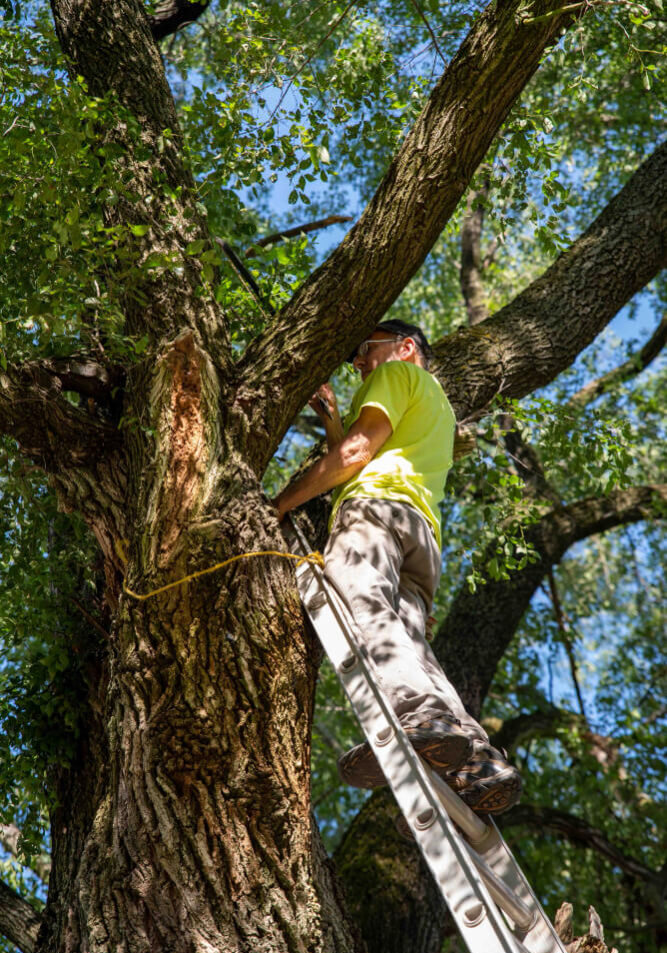
Sometimes that recommendation is direct. The tree is dead, unstable, and positioned where failure would create an unacceptable risk. Removal is the sensible choice. Other times, the answer is more measured. Reduce one overextended limb, install support, monitor over time, and address the stump from an earlier removal that has become a tripping issue. Good arborists do not force every problem into the same solution.
The most reassuring professionals I have encountered are not the ones who promise that nothing can go wrong. They are the ones who explain what they see, what they can control, and what they cannot. That is especially true with mature trees, storm damage, and properties where access is tight.
The real goal is clarity before the first cut
By the time a crew unloads ropes and saws, the important decisions should already be made. You should know why the tree is being removed or retained, who assessed it, whether risk-reduction options were considered, and what the finished site will look like. You should also know whether the job includes Stump Removal & Grinding, follow-up pruning, emergency stabilization, or a broader plan involving FireSmart Tree Services.
Tree work goes best when the owner asks careful questions and the contractor gives specific answers. That exchange protects the tree when it can be preserved, protects the property when removal is necessary, and protects everyone involved from preventable misunderstandings.
If a company welcomes that conversation, explains its reasoning, and puts the scope in writing, you are usually dealing with the right kind of professional.
Name: Ace Tree Services Ltd.
Address: 4656 Wallace Hill Road, Kelowna, BC
Phone: 250-212-9593
Website: https://acetree.ca/
Hours:
Monday: 7:00 AM–5:00 PM
Tuesday: 7:00 AM–5:00 PM
Wednesday: 7:00 AM–5:00 PM
Thursday: 7:00 AM–5:00 PM
Friday: 7:00 AM–5:00 PM
Saturday: 7:00 AM–5:00 PM
Sunday: Closed
Emergency tree services: 24/7 emergency service is listed.
Open-location code / Plus code: RHF8+8G Kelowna, British Columbia, Canada
Map/listing URL: https://www.google.com/maps/place/Ace+Tree+Services+Ltd./@49.8232606,-119.4337283,563m/data=!3m1!1e3!4m6!3m5!1s0x537d8b1d074815c5:0x450b88afa7a41435!8m2!3d49.8232606!4d-119.4337283!16s%2Fg%2F11ydkpnh22
Embed iframe:
Socials: https://www.facebook.com/people/Ace-Tree-Services/61585901931447/
https://m.yelp.com/biz/ace-tree-services-kelowna
Ace Tree Services Ltd. provides professional tree service for residential, commercial, and municipal customers in Kelowna and across the Okanagan Valley.
The company’s listed services include tree removal, stump removal and grinding, tree pruning and crown shaping, emergency tree services, certified arborist consultation, dangerous tree assessment, tree cable and bracing, and wildfire mitigation.
Ace Tree Services works with homeowners, businesses, property managers, and public-sector clients that need safe, practical tree care in the Kelowna area.
The official site highlights ISA-certified arborists, insurance, and experience handling both routine and complex tree service situations.
Customers can contact Ace Tree Services for tree care planning, hazard concerns, emergency tree cleanup, pruning needs, stump grinding, or advice about trees near homes, fences, driveways, and landscaping.
Ace Tree Services lists regular work hours from 7:00 AM to 5:00 PM Monday through Friday, with 24/7 emergency tree service available for urgent situations.
For tree service in Kelowna, call 250-212-9593 or visit https://acetree.ca/
The public map listing places Ace Tree Services Ltd. in Kelowna and can help customers find directions to the Wallace Hill Road area.
Popular Questions About Ace Tree Services Ltd.
What services does Ace Tree Services Ltd. provide?
Ace Tree Services Ltd. provides tree removal, stump removal and grinding, tree pruning and crown shaping, emergency tree services, certified arborist consultation, dangerous tree assessment and removal, tree cable and bracing, and wildfire mitigation.
Where is Ace Tree Services Ltd. located?
The official website lists Ace Tree Services Ltd. at 4656 Wallace Hill Road, Kelowna, BC.
What areas does Ace Tree Services Ltd. serve?
The official website describes Ace Tree Services as located in Kelowna and servicing the Okanagan.
What phone number should customers call?
Customers can call Ace Tree Services Ltd. at 250-212-9593.
What are Ace Tree Services Ltd.’s regular hours?
The official website lists work hours as 7:00 AM to 5:00 PM, Monday through Friday. Saturday and Sunday regular hours are not listed and should be confirmed directly.
Does Ace Tree Services Ltd. offer emergency tree service?
Yes. The official website lists 24/7 emergency services for urgent tree situations, including emergency tree removal, dangerous tree assessment, stabilization, and limb or branch cleanup.
Does Ace Tree Services Ltd. have certified arborists?
Yes. The official website states that Ace Tree Services has ISA-certified arborists.
Can Ace Tree Services Ltd. help with wildfire mitigation?
Yes. Wildfire mitigation is listed as one of the company’s tree services.
How do I contact Ace Tree Services Ltd.?
Call 250-212-9593 or visit https://acetree.ca/.
Landmarks Near Kelowna, BC
Wallace Hill Road: A local Kelowna road near the address listed for Ace Tree Services Ltd.
Okanagan Lake: A major Kelowna landmark near residential, commercial, and waterfront properties that may need tree pruning, removal, or hazard assessment.
Downtown Kelowna: A central area with homes, offices, rental properties, restaurants, and commercial sites that may need professional tree care.
Mission / Lower Mission: A well-known Kelowna area with mature landscaping, residential properties, and lake-adjacent homes.
South East Kelowna: A rural and residential area with larger properties, orchards, and tree-care needs that can include pruning, removals, and wildfire mitigation.
Crawford: A residential area near the southeast side of Kelowna where homeowners may need tree trimming, hazard assessment, and stump grinding.
Kettle Valley: A hillside residential neighborhood where tree condition, slope, wind exposure, and defensible-space planning can matter for property owners.
Myra-Bellevue Provincial Park: A major outdoor landmark near southeast Kelowna and a useful point of orientation for nearby properties.
Gallagher’s Canyon: A residential and golf community near southeast Kelowna where tree maintenance and wildfire-conscious vegetation management can be practical concerns.
Orchard Park Shopping Centre: A major central Kelowna retail landmark and reference point for customers traveling across the city.
Highway 97: A major Kelowna corridor connecting neighborhoods, commercial properties, and service routes throughout the region.
Kelowna City Park: A recognizable central landmark near downtown neighborhoods and lakefront properties.
Glenmore: A Kelowna neighborhood with residential and commercial properties that may need pruning, storm cleanup, and general tree care.
Rutland: A large residential and commercial area where customers may need tree removal, pruning, stump grinding, or arborist consultation.
Black Mountain: A hillside community where slope, wind, wildfire exposure, and access can influence tree service planning.
For tree service near these Kelowna landmarks, contact Ace Tree Services Ltd. at 250-212-9593 or visit https://acetree.ca/